- Home
- Hair Care Claim Substantiation Studies
Hair Care Claim Substantiation Studies

Hair Care Claim Substantiation Studies
Product Consumer Testing
Clinical Evidence for Hair Care products
Hair care brands operate in one of the most competitive categories in personal care. Claims such as “reduces hair fall,” “promotes hair growth,” “clinically proven anti-dandruff effect,” and “stronger hair in 8 weeks” directly influence purchasing decisions for consumers.
However, these claims must be backed by robust clinical evidence to meet regulatory expectations, advertising standards, and consumer scrutiny. Even milder claims such as “helps reduce hair fall” or “for strong hair” are scrutinised by regulators and consumers alike for evidence.
This is where ‘Hair care claim substantiation studies’ carried out by an experienced and qualified CRO provides scientifically validated data to support product claims, reduce regulatory risk, and strengthen brand credibility.
What Are Hair Care Claim Substantiation Studies?
Hair care claim substantiation studies are structured clinical or instrumental evaluations designed to verify whether a hair product delivers on the claims it is making.
These studies generate objective evidence to support:
- Hair fall reduction claims
- Hair growth and density claims
- Anti-dandruff and scalp health claims
- Hair strength and breakage reduction claims
- Shine, smoothness, and frizz control claims
They are typically conducted by specialized CROs like C.L.A.I.M.S. Pvt. Ltd. using standardized methodologies aligned with regulatory and advertising expectations.
Why Do Hair Care Claims Require Scientific Substantiation
1. High Consumer Sensitivity
Hair loss and scalp concerns are emotionally driven categories. Consumers expect visible, measurable results.
2. Regulatory & Advertising Oversight
Claims related to hair fall, growth, or hair strength or any such conditions can attract scrutiny if unsupported by scientific evidence.
3. Regulatory & Advertising Oversight
Clinically substantiated claims differentiate products in a crowded market and give the marketing teams confidence to design and execute their campaigns.
4. Legal Risk Reduction
Validated data protects brands from claim challenges and misleading advertising allegations.
Types of Hair Care Claims That Require Substantiation
- Reduces hair fall
- Minimizes breakage
- Strengthens hair
These typically require controlled clinical/instrumentation assessments over defined usage periods.
- Promotes hair growth
- Increases hair density
- Improves hair thickness
Such claims often require longer study durations aligned with hair growth cycles.
- Reduces dandruff
- Controls scalp flaking
- Soothes irritated scalp
These claims are evaluated using standardized clinical grading systems along with instrumentation.
- Reduces hair breakage
- Improves tensile strength
- Strengthens weak hair
These may involve instrumental testing.
- Improves shine
- Enhances smoothness
- Controls frizz
Often supported through Expert evaluation and consumer in-use studies.
How Are Hair Fall Reduction Claims Are Clinically Substantiated
Hair fall reduction claims are substantiated through controlled studies that measure hair shedding using standardized collection and counting methods over a defined product usage period.
Common approaches include:
- Controlled wash tests
- Hair count analysis
- Breakage evaluation
- Repeated-use studies
Study duration typically ranges from 4–12 weeks depending on claim strength.
Clinical vs Consumer Studies for Hair Care Claims
Study Type | Purpose | Suitable For |
|---|---|---|
Clinical evaluation | Semi-objective efficacy data | Hair fall, growth |
Instrumental testing | Measurable parameters | Density, strength |
Consumer studies | Perception & satisfaction | Shine, manageability |
Most efficacy-driven claims require clinical evidence, with consumer studies used as supportive data.
How Long Do Hair Care Claim Substantiation Studies Take?
Timelines depend on claim type:
- Short-term cosmetic claims: 3–6 weeks
- Hair fall reduction claims: 4–12 weeks
- Hair growth claims: 8–16 weeks
- Repeated-use safety studies: up to 6 months
Early planning ensures claims align with launch timelines.
Regulatory Expectations for Hair Care Claims
Regulators and advertising bodies generally expect:
- Scientifically justified study design
- Claim-relevant endpoints
- Ethical participant recruitment
- Robust and transparent documentation
Export-focused brands should ensure study protocols meet internationally accepted standards to avoid repeat testing.
How a CRO Designs Hair Care Claim Substantiation Studies
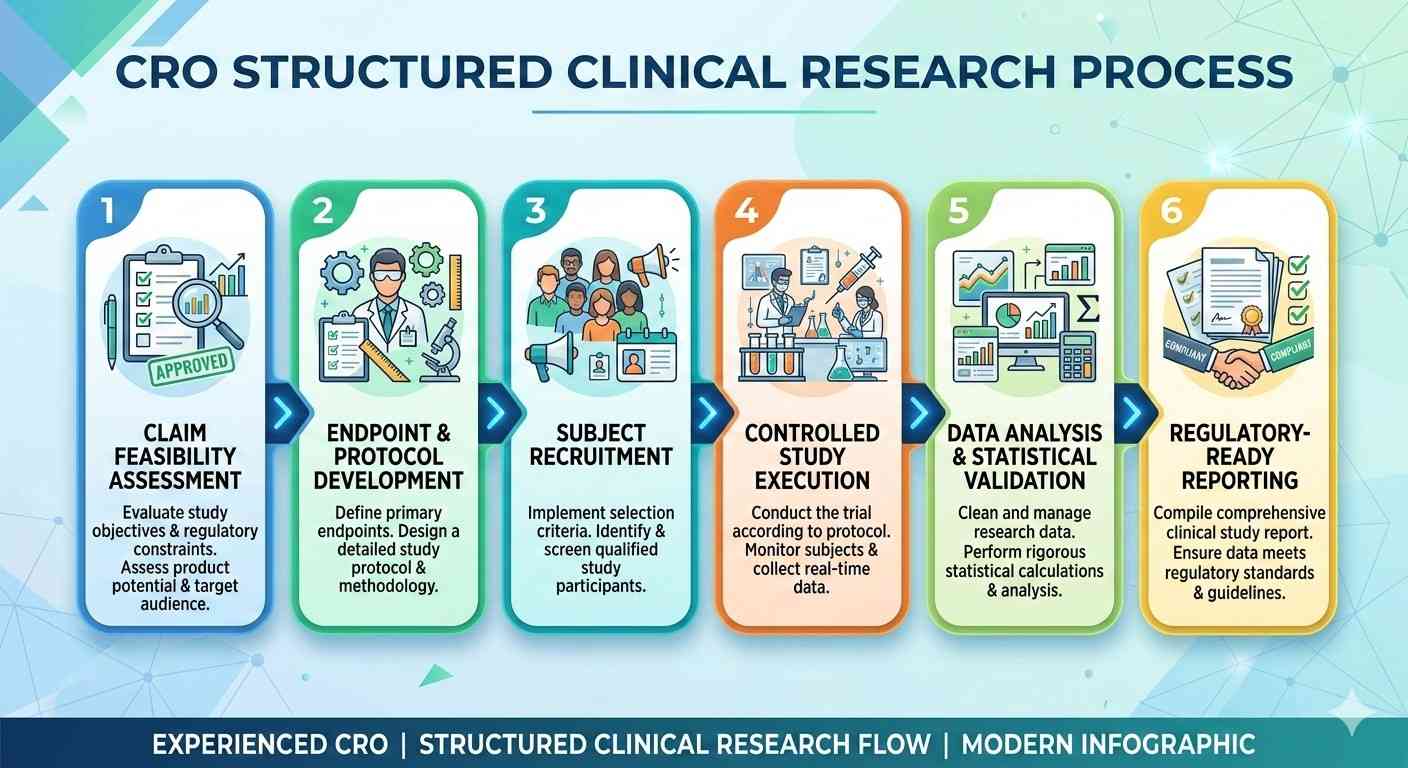
Early CRO involvement reduces rework and accelerates go-to-market timelines.
Common Mistakes in Hair Care Claim Substantiation
- Overstating hair growth claims
- Using only consumer perception data
- Inadequate study duration
- Poor endpoint selection
- Late CRO engagement
- Poor study design
Avoiding these pitfalls saves cost and protects brand credibility.
Why Choose a Specialized CRO for Hair Care Studies?
Hair care studies require understanding of:
- Hair growth cycles
- Shedding patterns
- Scalp condition assessment
- Instrumental measurement techniques
Working with a CRO experienced in hair care claim substantiation ensures reliable, regulator-ready data.
Plan Your Hair Care Claim Study with Confidence
Whether you are launching a new anti-hair fall shampoo, scalp serum, or conditioner for hair shine, early scientific validation strengthens both marketing and compliance strategy.
Discuss your product claims with our clinical experts and design a substantiation strategy aligned with your launch goals.