- Home
- Personal Care Claim Substantiation Studies
Personal Care Claim Substantiation Studies


Product Consumer Testing
Clinical evidence to validate cosmetic, skincare, haircare, and hygiene product claims.
In an era of heightened regulatory scrutiny and informed consumers, personal care brands must support marketing claims with scientific proof. Claim substantiation studies provide credible clinical evidence to validate safety, efficacy, and performance claims, thereby helping brands undertake marketing with confidence.
What Are Personal Care Claim Substantiation Studies?
Personal care claim substantiation studies are scientifically designed evaluations conducted to verify whether a cosmetic, skincare, haircare, or hygiene product delivers on its stated marketing claims. Such studies are conducted on human volunteers to generate objective, and often quantitative data that can be used for marketing support, regulatory review, and legal defence.
These are conducted by specialized Clinical Research Organizations (CROs) such as C.L.A.I.M.S. Pvt.Ltd. using validated methodologies in line with regulatory requirements.
- Marketing support
- Regulatory compliance
- Consumer trust
- Risk mitigation
Why Is Claim Substantiation Critical for Personal Care Brands?
- Regulatory & Advertising Scrutiny
Unsupported claims can lead to advertising objections, legal challenges, or forced claim removal.
- Consumer Trust & Brand Credibility
Today’s consumers actively seek science-backed claims such as “clinically proven” or “dermatologically tested,” which cannot be claimed without valid clinical studies that stand the scrutiny of regulatory bodies.
- Launch & Business Risk Reduction
Early claim validation prevents costly rework, delays, and reputational damage.
Types of Personal Care Claims That Require Substantiation
- Moisturization
- Anti-aging & wrinkle reduction
- Gloss & even skin tone
- Suitable for sensitive skin
- Hypoallergenic
- Dermatologically tested
- Non-comedogenic
- Mild on skin
- Hair fall reduction
- Hair growth & thickening
- Anti-dandruff
- Strong hair
- SPF & PA ratings
- Broad-spectrum protection
- Water- & sweat-resistance
- Visible improvement
- Long-lasting effect
- Product preference
Study Methodologies Used in Claim Substantiation
Instrumental Studies
Objective measurements using validated instruments to quantify product performance.
Clinical Evaluation Studies
Expert-led safety and efficacy assessments under controlled conditions on human volunteers or patients as required for the study.
In-Use & Consumer Studies
Real-life usage studies capturing user experience and perceived efficacy.
Before–After & Visual Assessments
Standardized photo-documentation to support appearance-based claims.
Examples of Instrumental vs Consumer Studies – Choosing the Right Evidence
Claim Type | Preferred Evidence |
|---|---|
Moisturization | Instrumental + Consumer |
Anti-aging | Instrumental + Clinical |
Sensitive skin | Clinical safety |
Hair fall reduction | Clinical + Instrumental |
Consumer preference | In-use studies |
The right evidence depends on the claim, not the trend.
Regulatory Expectations – India & Global Markets
While regulations differ across regions, regulators generally expect claim substantiation to be:
- Scientifically justified
- Claim-relevant
- Ethically conducted
- Clearly documented
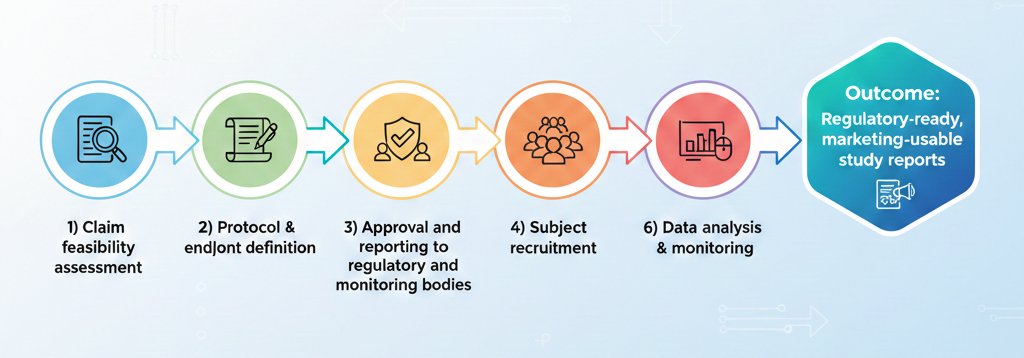
How a CRO Designs Claim Substantiation Studies
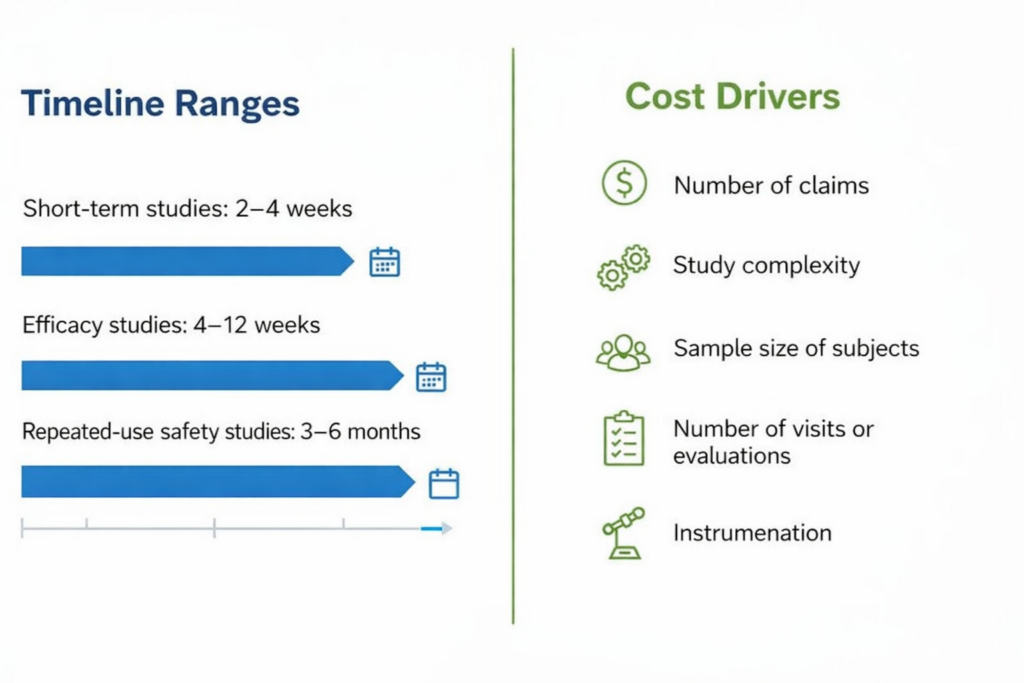
Typical Timelines & Cost Considerations
Common Claim Substantiation Mistakes to Avoid
- Locking claims before feasibility checks
- Relying only on perception studies
- Using non-relevant endpoints
- Involving CROs too late
Avoiding these mistakes saves time, cost, and regulatory risk.
Why depend on C.L.A.I.M.S. Pvt.Ltd. for Personal Care Studies
Key differentiators:
- Specialized personal care expertise
- Customized study design
- Regulatory-aligned protocols
- End-to-end CRO support
- Marketing-ready documentation
Trust Elements
Validate Your Personal Care Claims with Confidence
Whether you are launching a new product or strengthening existing claims, early scientific validation gives you a competitive edge.